
Is CapCut Safe?

Edited by
Ben Jacklin
38,896

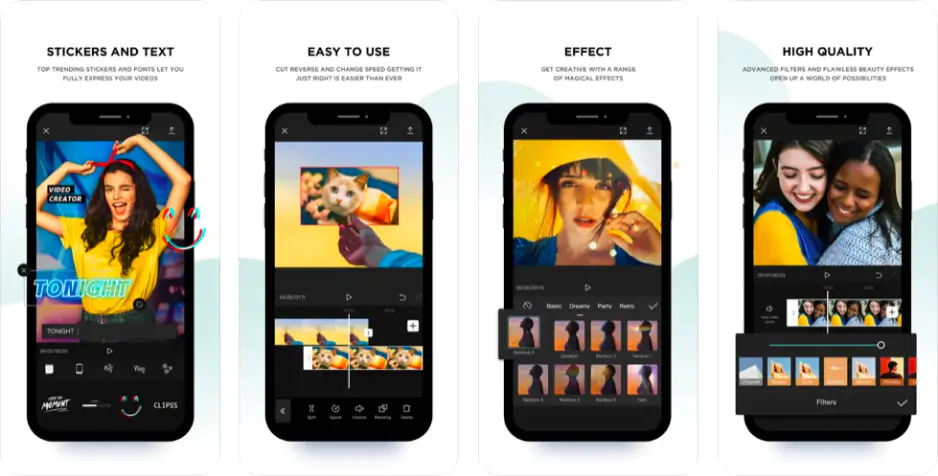
CapCut has become one of the most popular free video editors on the planet, and that popularity brings an obvious question: is CapCut safe? The short answer is yes, from a pure security standpoint. It's a legitimate app distributed through the Google Play Store, Apple App Store, and official website, and it isn't loaded with malware or hidden malicious code. The more complicated answer involves privacy. CapCut is owned by ByteDance, the company behind TikTok, and it collects a substantial amount of user data, which is why so many people search for "capcut privacy policy," "capcut safety concerns," and "is capcut safe for kids" before letting it anywhere near their devices or their children's phones. Below, we break down exactly what the privacy policy says, who your data might be shared with, whether it's appropriate for younger users or business teams, and what to use instead if you'd rather your footage never leave your computer at all.

What exactly does capcut collect – a privacy policy breakdown

Reading through CapCut's own privacy documentation makes clear that data collection here is broad, not incidental. According to the policy, when you register you provide your date of birth, email address, account password, and any linked social network accounts, along with optional profile details like gender. Beyond that, the app collects the content you create, upload, generate, or access – photos, videos, templates you view, comments, likes, and metadata about when, where, and by whom that content was made, and it's worth noting that content can be uploaded to CapCut's servers even before you choose to save or post it.

On the technical side, CapCut automatically logs your IP address, unique device identifiers, advertising identifiers, network type, device model and manufacturer, app version, operating system, screen resolution, system language, region, and battery information. The U.S. version of the policy adds that the company also collects communication information you send when contacting support, such as proof of identity or age and any data subject requests, and it separately maintains a Consumer Health Data Privacy Policy covering any information about your physical or mental health conditions that might come up while using the services, in compliance with state-level health privacy laws.

Independent reviewers summarize the same picture in plainer terms: CapCut collects account information like your name, username, email, and phone number; the content and activity data tied to what you upload and edit; device and technical details; and usage logs covering searches, settings, and crash reports. Location data is part of the mix as well – CapCut can infer your approximate location from your device's IP address, even without explicit GPS permission.

What data is shared with third parties

CapCut states it doesn't sell your personal information outright, but "not selling" and "not sharing" are different things. The company shares certain data with third parties for business and operational purposes, and it may share information such as your IP address and inferred location with advertising partners, along with data about how you interact with ads to measure campaign performance. The U.S. privacy policy confirms this directly, noting that advertising and measurement partners help promote the Services and gauge ad effectiveness, sometimes based on your activity across other websites and apps, and that payment providers receive purchase and technical information whenever you pay for something through the app. Data also moves between related corporate entities – information can be shared with TT Commerce & Global Services and other affiliates under common control, for what's described as a global and interoperable experience.

There's also a legal-disclosure angle: CapCut can hand data over to law enforcement if it's legally required to, or if it believes in good faith that disclosure is necessary to meet a legal obligation. Because CapCut's infrastructure has ties back to ByteDance, questions about cross-border data transfer and potential government access persist even though the company states user data is generally stored in Singapore and the United States – which is exactly why "capcut data privacy concerns" remains one of the most searched phrases connected to the app, and why it has faced restrictions in some countries over data-privacy and geopolitical concerns.

Is CapCut safe for kids?

This is where "is capcut safe" turns into a genuinely important parenting question, since CapCut is extremely popular with tweens and teens. The app itself isn't malware and won't infect a device, but the risk profile for kids is different from the risk profile for adults. The bigger concerns are exposure to mature template content, weak privacy awareness among younger users, public comment interactions, and the app's tight connection to posting on other social platforms. Importantly, CapCut has no built-in parental controls, and because it can be signed into with a TikTok, Google, Apple, Facebook, or email account, parents need to think about exactly which account is linked and what data comes attached to it.

The real-world risk usually isn't the app stealing data – it's kids oversharing without realizing it. Safety guidance specifically warns families to keep school names, home locations, and other identifying details out of videos that could later be reposted anywhere. And because CapCut is so often the first stop before publishing to TikTok, Instagram, or YouTube, the real question quickly stops being "is the editing app safe" and becomes "is the finished video safe to publish." On age policy, CapCut is generally positioned for users 13 and up, though official guidance for its Pippit platform is stricter: Pippit is intended only for adults, and the company states it does not knowingly collect personal data from anyone under 18. For families who decide to keep using CapCut, supervision, reviewing privacy settings together, and pairing it with a reputable parental-control app are the standard recommendations.

Is CapCut Safe for Business Use?

For freelancers, agencies, and in-house content teams, the calculus is a bit different than it is for a personal account. CapCut isn't going to compromise a company network the way malware would, but three things are worth weighing before it becomes part of a professional workflow: what happens to client footage once it's uploaded, whether pre-uploading (processing content before you've even hit save) fits your confidentiality obligations, and whether your industry has data-residency or compliance requirements that a cloud-based, ByteDance-operated service can't easily satisfy. Unreleased marketing material, client-owned footage under NDA, or anything involving personally identifiable customer information is generally not something you want touching a third-party cloud pipeline by default. Teams handling sensitive footage – legal, healthcare-adjacent, financial, or anything under strict client contracts – often find it easier to avoid the question entirely by editing on local software that never sends files anywhere.

Alternatives with local data storage: Movavi Video Editor
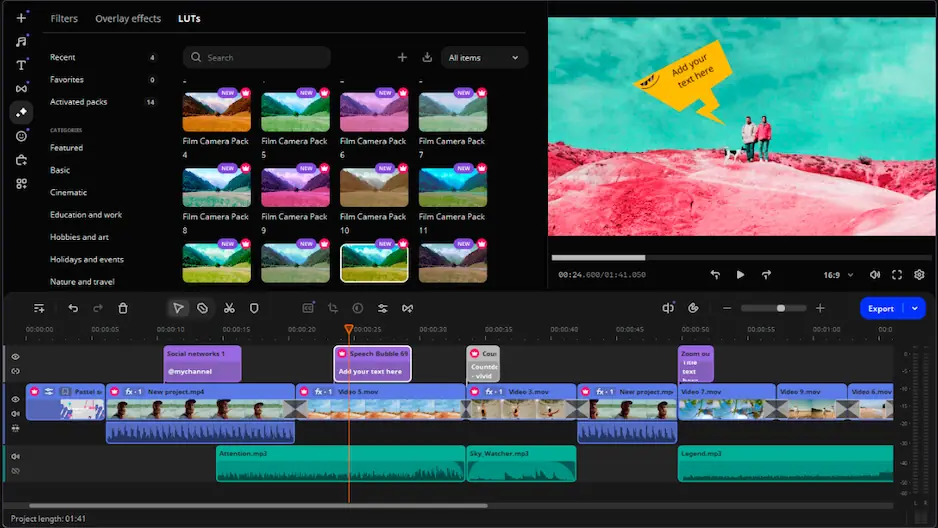
If the trade-off between CapCut's free tools and its data practices doesn't sit right with you, the most straightforward fix isn't a VPN or a settings deep-dive – it's switching to an editor that processes everything on your own machine in the first place.

That's the core appeal of desktop software like Movavi Video Editor: your clips, audio, and projects stay on your computer throughout editing and export, with nothing routed through a third-party cloud or handed to advertising partners. For anyone who searched "is capcut safe" specifically because of privacy, not malware, that's the actual difference that matters – no account required to edit, no automatic uploading of content before you save it, and no data-sharing terms to read through in the first place.

Movavi still covers the everyday essentials – trimming, transitions, color correction, templates – without the resource demands of professional-grade suites or the data footprint of a ByteDance-owned service, making it a practical option for anyone who wants their footage to stay exactly where they left it: on their own hard drive.
Have questions?
If you can’t find the answer to your question, please feel free to contact our Support Team.
Join us for discounts, editing tips, and content ideas

1.5M+ users already subscribed to our newsletter

By signing up, I agree to receive marketing emails from Movavi and agree to Movavi's Privacy Policy.