
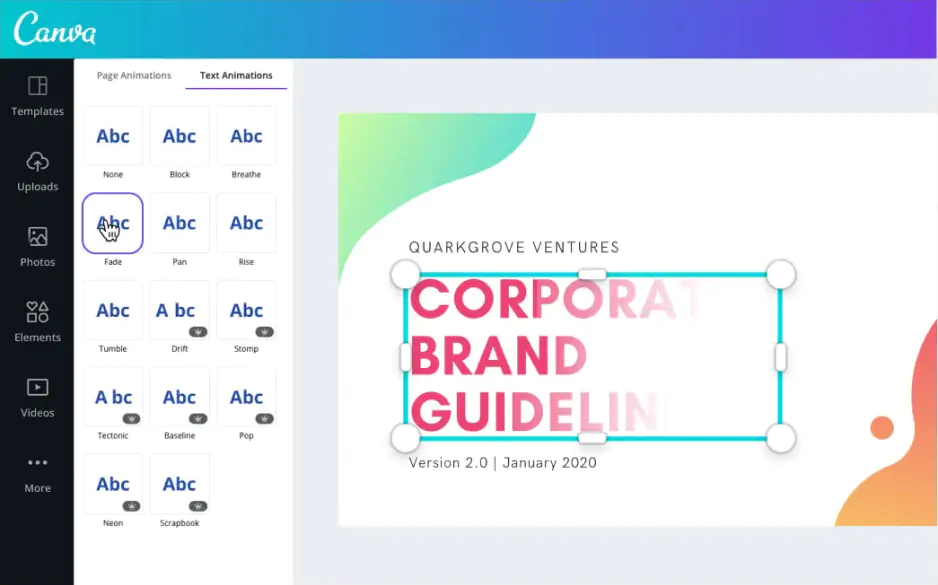
Canva Copyright Explained: Rules for Commercial Use

Edited by
Ben Jacklin
4,177

Understanding Canva copyright policy is essential before you use any design for business purposes. Canva offers thousands of free and paid elements, but not every image, font, or template can be used commercially without limits. Knowing what you own, what you license, and what stays off-limits protects you from legal trouble and helps you create with confidence. This guide breaks down exactly how Canva's copyright works for commercial use.

Understanding Canva's licensing terms

Many people assume that anything inside Canva is free to grab and reuse however they like. That assumption can lead to serious mistakes. So, are Canva images copyright free? The short answer is no. Nearly every element you find in the platform is protected by copyright and made available to you through a license, not handed over as your personal property.

A license is simply permission to use something under specific conditions. When you drop a photo, icon, or graphic into your design, Canva allows you to use it, but the original creator or Canva itself still holds the underlying rights. You are borrowing the content within agreed boundaries rather than buying it outright.

This distinction matters because it shapes what you can legally do next. You may print, post, or publish your finished design in most cases, yet you cannot resell the raw element on its own, register it as a trademark, or claim you created it.

Canva divides its permissions into a free license and a Pro license, each with its own scope. The terms cover where content can appear, how often, and whether money is involved.

Reading these conditions once saves you from guesswork later and keeps your commercial projects on solid legal ground.

Can you use Canva templates and assets commercially?

When it comes to real projects, the question people ask most is simple: are Canva elements copyright free, and can they be used to make money? Templates, photos, illustrations, videos, and audio tracks can all be used commercially in the vast majority of cases, provided you follow the platform's rules and adjust the design to make it your own.

Templates deserve special attention. If you customize a template with your own text, colors, and layout, you can confidently use it for marketing materials, social posts, client work, or products you sell. What you cannot do is share or distribute the blank template itself as though it were your original creation.

Individual assets follow a similar logic. A stock photo or graphic can appear in your branding, packaging, or promotional content, but it cannot stand alone as the product. Selling an unedited image as a downloadable file, a print, or a stock asset falls outside what the license permits, because the value would come entirely from Canva's content rather than your design work.

For most business owners, creators, and freelancers, this leaves plenty of room to operate. As long as your final piece reflects genuine design effort and the asset is part of something larger, you can build commercial projects on Canva's library with peace of mind.

Using Canva music on YouTube and social platforms

Music is where creators run into the most confusion, because audio licensing tends to be stricter than image licensing. Canva provides a library of tracks you can add to videos, and in most cases you are free to publish those videos on YouTube, Instagram, TikTok, and similar platforms, as long as the music stays inside the video you designed.

The key rule is that the soundtrack must remain part of a larger project. You can pair a Canva track with your visuals, export the finished video, and share it publicly. What you cannot do is pull the audio out on its own, redistribute it, or use it as a standalone file, since the music is licensed for use within your designs only.

Monetization deserves a closer look. Publishing a video that earns ad revenue is generally acceptable, but occasionally a track may trigger an automated content-ID claim on YouTube. It usually means the system flagged a match that you can dispute or clear.

To stay safe, keep records of the tracks you use and check whether a song is marked Pro or free. A quick review before uploading protects your channel from unexpected takedowns or disputes.

How to credit Canva content

Most Canva copyright rules do not require you to credit Canva or the original artist when you publish a design, which makes the platform convenient for everyday use. Attribution becomes necessary only in specific situations, such as when a particular element is offered under a Creative Commons or free-media license that asks for a mention.

Because Canva images copyright status can vary by element, the safest habit is to check each item's license details before publishing. When credit is requested, a short line naming the creator and source satisfies the requirement and keeps your project fully compliant.

Copyright-free vs. royalty-free: What's the difference?

These two terms sound alike but mean very different things. Copyright-free implies no one holds rights to the work, so it can be used freely without permission, which is rare in practice. Royalty-free, by contrast, means you pay once (or access through a subscription) and then reuse the content without ongoing fees, though the creator still owns it. Most copyright protections in Canva fall into the royalty-free category, meaning you gain broad usage rights through your plan while ownership stays with Canva or the artist.

Alternative: Movavi Video Editor
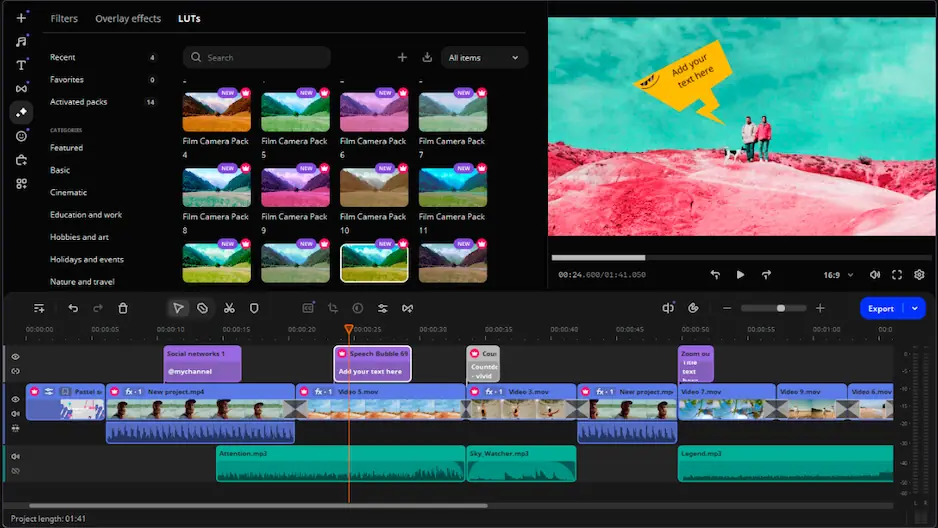
If your projects lean heavily toward video, a dedicated desktop editor can give you more control than a browser-based tool. Movavi Video Editor is a solid choice for creators who want to work offline, handle larger files, and fine-tune their footage frame by frame. It offers a built-in library of stock media, music, and effects, so you can source assets and edit them in one place without juggling multiple platforms.

Movavi Video Editor is especially friendly to beginners, with a clean interface and drag-and-drop editing that shortens the learning curve. At the same time, it packs advanced features like keyframe animation, color adjustment, and audio syncing for those ready to go further. For anyone producing commercial videos regularly, it pairs nicely with design work and gives you a dependable workspace on your own computer.
Have questions?
If you can’t find the answer to your question, please feel free to contact our Support Team.
Join us for discounts, editing tips, and content ideas

1.5M+ users already subscribed to our newsletter

By signing up, I agree to receive marketing emails from Movavi and agree to Movavi's Privacy Policy.